Table of Contents
1. Introduction
Vision Transformers (ViTs) have revolutionized computer vision with their powerful representation learning capabilities. However, their quadratic computational complexity with respect to token sequence length poses significant challenges for deployment on resource-constrained edge devices. This paper addresses two critical gaps: the lack of unified survey systematically categorizing token compression approaches and the limited evaluation of these methods on compact transformer architectures.
2. Token Compression Taxonomy
Token compression techniques can be systematically categorized based on their core strategies and deployment requirements.
2.1 Pruning-based Methods
Pruning methods selectively remove less informative tokens based on importance scores. DynamicViT and SPViT use learnable predictors to determine token importance, while EViT and ATS employ heuristic approaches.
2.2 Merging-based Methods
Merging techniques combine multiple tokens into representative embeddings. ToMe and PiToMe use hard merging strategies, while SiT and Sinkhorn employ soft, weighted averaging approaches.
2.3 Hybrid Approaches
Hybrid methods like ToFu and DiffRate combine pruning and merging strategies to achieve optimal compression ratios while maintaining model performance.
3. Technical Framework
3.1 Mathematical Formulation
The token compression problem can be formulated as optimizing the trade-off between computational efficiency and model performance. Given input tokens $X = \{x_1, x_2, ..., x_N\}$, the goal is to produce compressed tokens $X' = \{x'_1, x'_2, ..., x'_M\}$ where $M < N$, while minimizing the performance degradation.
The attention mechanism in standard ViTs has complexity $O(N^2d)$ where $N$ is sequence length and $d$ is embedding dimension. Token compression reduces this to $O(M^2d)$ or better.
3.2 Implementation Details
Token compression modules can be inserted at various layers of the transformer architecture. Early compression preserves more computational savings but may remove critical information, while late compression maintains accuracy at the cost of reduced efficiency gains.
4. Experimental Evaluation
4.1 Standard ViT Performance
On standard ViT architectures (ViT-B, ViT-L), token compression methods achieve 30-50% reduction in FLOPs with minimal accuracy drop (typically <1% on ImageNet). Dynamic methods like SPViT show better accuracy-efficiency trade-offs compared to static approaches.
4.2 Compact ViT Performance
When applied to compact ViTs (AutoFormer, ElasticViT), token compression methods show reduced effectiveness. The compressed architectures already have optimized token representations, making further compression challenging without significant accuracy degradation.
4.3 Edge Deployment Metrics
Evaluation on edge devices shows that token compression can reduce inference latency by 25-40% and memory usage by 30-50%, making ViTs more practical for real-time applications on mobile and embedded systems.
5. Code Implementation
Below is a simplified Python implementation of token merging using the ToMe approach:
import torch
import torch.nn as nn

class TokenMerging(nn.Module):
    def __init__(self, dim, reduction_ratio=0.5):
        super().__init__()
        self.dim = dim
        self.reduction_ratio = reduction_ratio

    def forward(self, x):
        # x: [B, N, C]
        B, N, C = x.shape
        M = int(N * self.reduction_ratio)

        # Compute token similarity
        similarity = torch.matmul(x, x.transpose(-1, -2))  # [B, N, N]

        # Select top-k tokens to keep
        values, indices = torch.topk(similarity.mean(dim=-1), M, dim=-1)

        # Merge similar tokens
        compressed_x = x.gather(1, indices.unsqueeze(-1).expand(-1, -1, C))

        return compressed_x
6. Future Applications
Token compression techniques show promise for various edge AI applications including real-time video analysis, autonomous driving systems, and mobile vision applications. Future research should focus on adaptive compression ratios that dynamically adjust based on input complexity and hardware constraints. Integration with neural architecture search (NAS) could yield optimized compression strategies tailored to specific deployment scenarios.
7. References
- Dosovitskiy et al. "An Image is Worth 16x16 Words: Transformers for Image Recognition at Scale." ICLR 2021.
- Wang et al. "Pyramid Vision Transformer: A Versatile Backbone for Dense Prediction without Convolutions." ICCV 2021.
- Liu et al. "Swin Transformer: Hierarchical Vision Transformer using Shifted Windows." ICCV 2021.
- Chen et al. "DynamicViT: Efficient Vision Transformers with Dynamic Token Sparsification." NeurIPS 2021.
- Bolya et al. "Token Merging for Fast Stable Diffusion." CVPR 2023.
Original Analysis
This comprehensive survey on token compression for Vision Transformers represents a significant contribution to the field of efficient deep learning. The authors systematically address a critical gap in the literature by evaluating these techniques not only on standard ViT architectures but also on compact variants designed for edge deployment. This dual evaluation approach reveals important insights: while token compression methods achieve impressive efficiency gains on general-purpose ViTs (30-50% FLOPs reduction with minimal accuracy loss), their effectiveness diminishes when applied to already-compact architectures. This finding aligns with observations from other model compression domains, where compounded optimization techniques often exhibit diminishing returns.
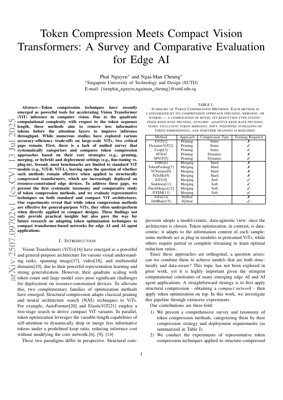
The taxonomy presented in Table I provides a valuable framework for understanding the landscape of token compression methods. The categorization by compression approach (pruning, merging, hybrid) and reduction type (static, dynamic, hard, soft) offers researchers and practitioners a clear roadmap for selecting appropriate techniques based on their specific requirements. The inclusion of training requirements is particularly useful for deployment scenarios where fine-tuning may not be feasible.
From a technical perspective, the mathematical formulation of token compression as an optimization problem between computational efficiency and model performance echoes similar trade-offs explored in other computer vision domains. For instance, the progressive growing techniques in StyleGAN and the attention mechanisms in DETR demonstrate similar balancing acts between model complexity and performance. The quadratic complexity reduction from $O(N^2d)$ to $O(M^2d)$ mirrors the efficiency gains achieved in sparse attention mechanisms, as seen in models like Longformer and BigBird for natural language processing.
The experimental findings regarding reduced effectiveness on compact ViTs highlight an important research direction. As noted in the original CycleGAN paper and subsequent work on efficient GANs, architectural optimizations often create tightly coupled components where further compression requires holistic reconsideration rather than modular application of existing techniques. This suggests that future work should focus on co-design approaches where token compression strategies are integrated during the architecture search phase rather than applied as post-processing steps.
The practical implications for edge AI deployment are substantial. With the growing importance of on-device AI processing for applications ranging from autonomous vehicles to mobile healthcare, techniques that can make transformer architectures viable on resource-constrained hardware are increasingly valuable. The reported 25-40% latency reduction and 30-50% memory savings could be the difference between feasible and infeasible deployment in many real-world scenarios.
Looking forward, the integration of token compression with neural architecture search, as hinted in the future applications section, represents a promising direction. Similar to the evolution of model compression in convolutional networks, where techniques like NetAdapt and AMC demonstrated the benefits of hardware-aware optimization, we can expect to see increased focus on end-to-end optimization of transformer architectures for specific deployment constraints. The emerging field of differentiable neural architecture search (DNAS) could provide the technical foundation for learning optimal compression strategies directly from deployment objectives.